Pulse Diagnosis for Pregnancy and Baby Gender Prediction
"Congratulations, you’ve got a happy pulse!" When a Chinese medicine practitioner tells you so, it means that you are pregnant.
Chinese medicine practitioners (CMP) diagnose patients mainly through four examinations, which are "observing", "smelling", "listening and asking questions", as well as "touching".
- Observing the color and brightness of the face, tongue, eyes and other parts of the body. Listening to the patient’s voice and breathing.
- Smelling if there are unusual odors from the body of the patient especially the breath.
- Checking the body conditions of the patient by asking questions, such as eating and bowel habit, sleeping pattern at night, and sensibility to temperature.
- Touching and feeling the warmth of hands. Palpating pulses at the wrists.
It is the fourth diagnostic technique that the CMP can feel the development of a new life, as a lot of changes occur in the cardiovascular system after conception. Changes include an increase in the amount of circulating blood, increase in the oestrogen levels, increase of heart rate to 10-15 bpm, increase in basal metabolic rate and more. With such changes, CMP can detect pregnancy even earlier than using a pregnancy test tube.
Gender Diagnosis
You probably heard about the Chinese Gender Chart, which has been used to predict the gender of an unborn child. The result of the prediction however is still questionable, as there is no scientific backup for the chart. Gender detection by pulse diagnosis, on the order hand is more concrete and scientific.
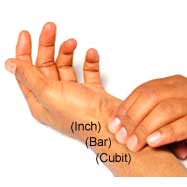 |
| Pulse diagnosis |
Chinese medicine practitioners use pulse diagnosis for gender detection during pregnancy. The most commonly used pulse location is the radial artery. CMP divide wrist pulse into three sections, which are the cubit (chi), the bar (guan) and the inch (cun). They use the pulp of index, middle and ring fingers touch and press your radial artery with different level of finger force during the diagnosing. At the early stage of pregnancy, the pulses at the inch position of the left hand come and go smoothly, and happen almost slippery. At the same time, the beats at the cubit and the bar positions may also be detected smooth and slippery. As the fetus grow, the slippery pulse in left inch position, and both cubit positions will become stronger and more obvious.
In general, women’s pulse normally weaker than men’s. CMP believes that “male with essence to use, female with blood-based”. The studies of modern medical have proven that pulse and output of cardiac are related, male and female have different level of cardiac output, therefore, their pulses will be different as well.
In Chinese Medicine theory, male is Yang, female is Yin; and left is also Yang whereas right is Yin. In his book Bin Hu Mai Xue (瀕湖脈學)* published in 1564, Li Shi Zhen (李時珍) who is considered to be the the greatest herbalists in Chinese history, pointed out that,
| " If the fetus is predicted as a boy, the left cubit pulse feels more slippery and rapid and the abdomen becomes swollen like the base of a wok. If the fetus is predicted as a girl, the right cubit pulse feels more slippery and rapid and the abdomen becomes swollen like a bamboo wheelbarrow. " |
 |
Published in 1742, the Chinese medical encyclopedia Yi Zong Jin Jian (醫宗金鑒)**, shared the same view about gender predicton.
" It is a boy if slippery pulse on the left, and it is a girl if on the right,
During pregnancy, there may be lactation.
The tummy will be like a cauldron is the fetus is a boy, and a winnowing basket if the fetus is a girl. "
|
 |
There are more than 20 different types of pulses, an experienced practitioner can identify 28 or even 29 types. A slippery pulse feels smoothly flowing and uninhibited, like pearls rolling in the vessel. If the left pulse feels more slippery and rapid than the right pulse, then the fetus is predicted as a boy, otherwise the fetus is predicted as a girl.
If the slippery pulses in both cubit positions are pretty much the same, the woman could be carrying twins. To make the outcome more accurate, diagnosis must be made in the morning. Of course, only experienced Chinese medicine practitioners can precisely diagnose slippery pulses and the gender of unborn babies.
* Pulse Diagnosis : Li Shi Zhen. Translated by Hoc Ku Huyuh 1965
** Yi Zong Jin Jian (醫宗金鑒) compiled by Wu Him (吳謙), a famous count physician in Qing dynasty
See also
- Chinese Herbal Medicine For Removing Blockage In The Fallopian Tubes
Chinese Herbal Medicine - an effective way to cure infertility by removing blockage in the fallopian tubes
- Acupuncture and TCM on Male Infertility
How TCM and acupuncture treats male infertility like improve sperm quality, sperm motility and sperm morphology
- The Essence of Basal Body Temperature and Cervical Mucus on Treatment of Infertility
The importance of charting basal body temperature and cervical mucus on the treatment of infertility
|